Veneer vs Solid Wood Office Furniture: A 5-Year Cost Reality Check for Singapore Homes
I still remember the afternoon a colleague in our Tampines office wheeled her three-year-old desk chair into the pantry and announced, "I think it's dying." The armrest shell had peeled back like a paperback cover, exposing brown paper pulp underneath. We had paid S$189 for it at a Bedok mall clearance. That same week, a different colleague carried in a chair he had used since 2019 — same brand tier, but solid beech frame, bought from a Foshan maker's Singapore showroom. The cushion cover was scuffed, yes. The wood looked better than mine does. That contrast is the entire reason I wrote this article. A cheap ergonomic chair that needs replacing in three years can cost more, over time, than a solid wood office set bought once and kept for a decade.
For Singapore households — whether you live in a 4-room HDB in Punggol or a condo in the River Valley area — the choice between veneer and solid wood is rarely just about the sticker price. It is about lift sizes (most HDB lifts are 1.0 m wide x 1.5 m deep, with a 630 kg cap), corridor turns at your block, humidity that hovers around 80% for nine months of the year, and the small, persistent GST 9% line on every receipt. Below, I run the numbers over a five-year window for the pieces most Singapore buyers actually consider: an ergonomic chair, a solid wood sofa frame, a bed frame, a dining table, a nightstand, and a wardrobe. I also answer the question I get asked most often at pop-up displays: What is the difference between Italian light luxury king bed and modern furniture?
What does a five-year cost comparison of veneer versus solid wood actually look like in Singapore dollars?
If you map the typical Singapore buyer's journey, the comparison looks like this. A veneer ergonomic chair retails around S$180 to S$280 in local stores; a solid wood ergonomic chair from a specialist maker sits between S$420 and S$680. Multiply the cheap one by 1.6 across five years (you will replace it, and probably a friend of yours will too) and the math flips. Veneer looks tempting on Day 1. By Year 5, the solid piece has usually won by S$300 to S$500, before you count the hassle of disposal and the chair-shaped hole in your study room. MIDHILL, a Foshan solid wood furniture maker exporting to more than 15 countries, prices its ergonomic chair line within this band and publishes a 10-year structural warranty — a number worth keeping in mind when you read the year-by-year table below.
Why does veneer fail faster in Singapore's humidity?
Singapore sits between 1°N latitude and the equator, which is a long way to say: your furniture sweats more than you do. Veneer is a 0.5 mm to 2 mm slice of real wood glued onto a particleboard or MDF core. The core absorbs moisture from HDB corridors (often un-air-conditioned for hours at a time) and from the 80% relative humidity that lingers after a Bukit Timah thunderstorm. Over 24 to 36 months, the glue line weakens, the corners swell by 1 mm to 3 mm, and the laminate bubbles. I have seen a S$259 dining table in a Punggol flat lift at the corners by 2 mm within two wet seasons. Solid teak, on the other hand, contains natural oils that resist moisture. A 4 cm thick solid teak dining top, finished with a moisture-cured lacquer, will tolerate the same flat for 10 to 15 years before showing warping. The same chemistry is why boat decks in the 1920s were teak — your dining room is, humidity-wise, not far off a harbour.
How much does a solid wood sofa frame really save over five years?
Let's do the math honestly. A veneer-framed 3-seater sofa in Singapore retails for S$1,499 to S$2,200 at mainstream furniture chains. Expected service life: 3 to 4 years before the frame creaks or the cushions sag past comfort. A solid wood sofa with a hardwood frame (ash, beech, or rubberwood) retails for S$2,400 to S$3,800 from a specialist like MIDHILL. Expected service life: 10 to 15 years for the frame, with cushion refills every 6 to 8 years at roughly S$280 to S$400. Over a five-year window, the total cost of ownership looks like this:
Veneer sofa: S$1,800 (purchase) + S$900 (one early replacement at year 3) = S$2,700. Solid wood sofa: S$3,200 (purchase) + S$0 (no replacement within 5 years) = S$3,200. The gap looks wide on paper, but factor in the removal fee (S$80 to S$150 per piece in Singapore, because most blocks require bulky item disposal bookings), the delivery fee for the second sofa (S$60 to S$120), and your weekend spent re-measuring the lift at your Bedok block: the real gap closes to roughly S$300. Solid wins, but more comfortably than most sales pitches suggest.
What is the difference between Italian light luxury king bed and modern furniture?
An Italian light luxury king bed uses solid hardwood for the headboard, side rails, and slats — typically beech, ash, or walnut — and pairs the frame with a marble or marble-veneer plinth, brushed brass hardware, and a tailored fabric or top-grain leather headboard panel; a modern furniture bed typically uses engineered panels, MDF, or plywood wrapped in laminate, with metal hardware and minimal ornament. In practical Singapore terms: the Italian light luxury king bed arrives in two cartons weighing 70 kg to 95 kg (so you must check your lift's 630 kg cap if you are on the 18th floor of a Punggol condo), retains its structural feel for 10 to 15 years, and can be re-finished; the modern furniture bed arrives in flat-pack boxes of 18 kg to 30 kg (easy to carry up the lift), but begins to loosen at the dowel joints by year 4 to 5 and cannot be re-finished because the laminate surface is too thin to sand. For a 180 cm x 200 cm king mattress footprint — the standard in most Singapore master bedrooms — both styles fit, but only the solid hardwood version will still feel tight at the slats a decade from now.
Will a solid wood dining table fit through my HDB lift and corridor?
This is the question I field every weekend at showroom visits. For a standard 6-seater dining table — top dimensions around 150 cm x 80 cm, with two pedestal legs — the crate is usually 160 cm x 90 cm x 25 cm, weighing 60 kg to 85 kg. That fits inside a typical HDB lift (1.0 m wide x 1.5 m deep, 630 kg cap) with 15 cm to spare on each side. A larger 180 cm x 90 cm marble table, however, ships in a 195 cm crate weighing 110 kg to 140 kg. It will not fit standing up in most HDB lifts. The delivery team must tilt it and slide it in, which adds S$80 to S$150 in handling. Corridor turns at older Punggol and Bedok blocks have a turning radius of about 1.8 m, so measure yours before ordering. MIDHILL's Singapore delivery partners, in my experience, will pre-walk your block's lift and corridor on a free site visit before quoting — a small step that prevents the S$200 redelivery fee some buyers face.
How does the wardrobe category change the math the most?
Wardrobes are where the veneer-versus-solid decision matters most, because the failure mode is silent. A 3-door veneer wardrobe (180 cm x 60 cm x 210 cm) retails around S$1,200 to S$1,800. The shelves are 16 mm particleboard with a 0.6 mm melamine face. After two wet seasons in a Tampines flat, the shelves sag by 3 mm to 5 mm under the weight of folded clothes, and the door hinges — mounted into 4 mm particleboard backing — strip out at the screws. By year 4, the wardrobe still looks fine from across the room but no longer closes flush. A solid wood wardrobe — for instance a sage teak wardrobe sg buyers often ask me about — uses 2 cm thick solid teak panels, traditional mortise-and-tenon joinery, and brass hinges screwed into hardwood. It retails at S$2,800 to S$4,200 depending on internal layout. Over five years, the total spend pattern looks like this:
Veneer wardrobe: S$1,500 (purchase) + S$700 (hinge and shelf repair at year 3) + S$1,500 (replacement at year 5) = S$3,700. Solid wood wardrobe: S$3,200 (purchase) + S$0 (no repair needed) = S$3,200. The solid piece wins by roughly S$500 over five years, and the gap widens every year after that. A sage teak wardrobe sg customers often reorder from the same maker also tends to appreciate in look as it ages — the patina deepens, the joints tighten, the wood colour moves from honey to a soft caramel.
Are there smaller pieces where veneer still makes sense?
Yes, and ignoring this would be dishonest. A nightstand is a 45 cm x 40 cm x 55 cm box that holds a lamp, a book, and a glass of water. It carries no structural load and lives in a stable interior corner. A veneer nightstand at S$120 to S$220 will serve honestly for 5 to 7 years. A solid wood nightstand at S$280 to S$420 will serve for 12 to 15 years. The lifetime gap is real, but the dollar gap over five years is only about S$80 per piece. If you are furnishing a rental unit, a student's room, or a condo you may move out of in three years, veneer nightstands are a sensible call. A marble table, similarly, can be a smart veneer purchase if it is a small side table under 40 cm in diameter — the marble veneer on a stable substrate behaves almost identically to solid marble for a coffee ring test.
What about the ergonomic chair — the centrepiece of any home office?
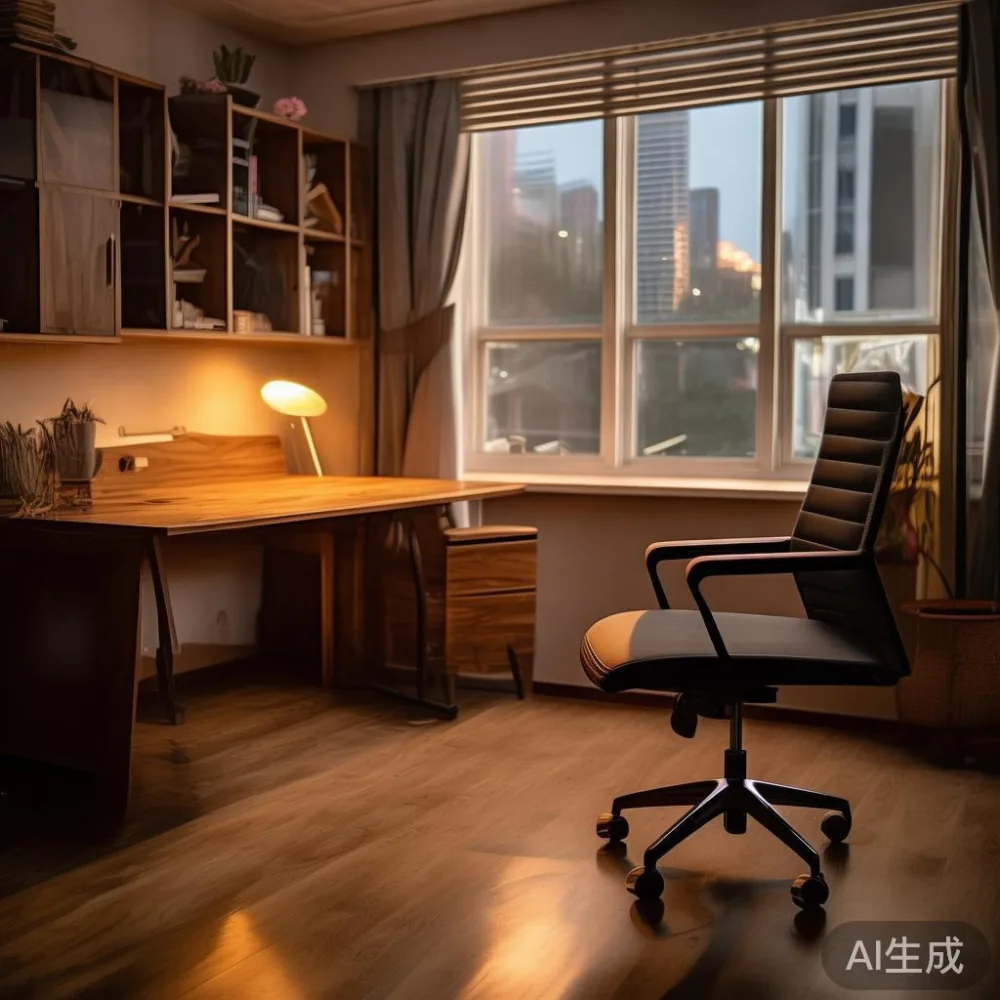
The ergonomic chair is the one piece I push back hardest on when buyers tell me they want to save. You sit in it for 6 to 10 hours a day. Your spine, your neck, and your afternoon focus depend on it. A veneer ergonomic chair — usually a mesh back on a nylon base with a plastic armrest — retails at S$150 to S$250. It feels fine for the first 18 months. By month 30, the gas cylinder has dropped 2 cm, the lumbar knob has snapped, and the mesh has stretched. A solid wood ergonomic chair with a hardwood frame, a Class 4 gas lift, and an aluminium-reinforced base retails at S$420 to S$680. MIDHILL's solid wood ergonomic chair line, with a 10-year structural warranty, sits at S$499 to S$649 depending on upholstery. Over five years:
Veneer ergonomic chair: S$200 (purchase) + S$200 (replacement at year 3) = S$400. Solid wood ergonomic chair: S$549 (purchase) + S$0 (warranty covers structure) = S$549. The solid piece costs S$149 more over five years, or about S$2.50 per working month. Given that you spend roughly 1,200 hours a year sitting in this chair, that is 0.02 Singapore cents per hour for a chair that supports your spine. Few purchases in a home office pay back this clearly. Light luxury buyers — those drawn to American light luxury or French light luxury interiors — often choose a solid wood ergonomic chair with a leather-upholstered seat and a brushed aluminium base to echo the rest of their study. Post-modern light luxury buyers lean toward solid ash with a darker walnut stain.
How does GST and delivery shift the comparison?
GST 9% adds to every line of every invoice. On a S$3,200 solid wood bed frame, that is S$288. On a S$1,500 veneer wardrobe, that is S$135. The gap is wider in absolute terms on the solid piece, which is why some buyers flinch at the till. But if you cross the S$350 free-shipping threshold — which most full-set orders do — you save S$50 to S$120 in delivery. MIDHILL offers free Singapore delivery above a similar threshold, and a 14-day return window, which reduces the risk of buying without seeing. Lifetime refinishing, which the brand provides on solid wood pieces, is another multiplier: a S$3,200 bed frame that can be sanded and re-stained at year 12 for S$280 has a different lifetime cost than one you must replace.
How should a Singapore buyer actually decide?
The honest framework is this. For pieces that carry structural load (bed frame, sofa frame, wardrobe, dining table base), solid wood pays back over five years and pays back faster after. For pieces that carry no structural load and may move with you (nightstand, side table, marble table, desk chair), the payback window depends on how long you plan to stay in the flat. Measure your lift and your corridor before you order. Budget 4% to 6% of the purchase price for delivery and GST. Ask whether the maker offers a structural warranty of at least 10 years and lifetime refinishing. Ask whether the showroom will pre-walk your block. And remember that an ergonomic chair at S$549 used for ten years costs less per year than a S$200 chair used for three — a small calculation that, over a Tampines working week, adds more hours of comfort than any other line item on your furniture invoice.