Humidity, HDB Corridors, and the Solid Wood Furniture Singapore Buyers Keep Asking About
Walk into a Tampines 4-room HDB flat on a wet August afternoon and you can almost feel it in the air: the Relative Humidity reading on the wall hygrometer sits stubbornly between 78% and 92%. That is the working environment every piece of solid wood furniture in your home has to survive, year after year. Last month I visited a friend’s resale flat in Bedok where a 1.8 m teak dining table, bought nine years ago from a local dealer, had developed a 3 mm bow right across the centre plank. Two doors down, a family in Punggol had a more cheerful story: their solid oak wardrobe from a Foshan workshop has held its shape through three monsoons, with only a light refinishing done at year two. The difference is rarely luck. It is material choice, joinery, and how the piece was acclimatised before it crossed the Causeway strip into a Singapore bedroom.
As someone who spends half the year testing wood furniture for a manufacturing brand and the other half fielding questions from Singapore buyers, I have seen how the city-state’s specific climate — equatorial, air-conditioned indoors but humid in every corridor, lift lobby, and service yard — punishes pieces that were built for drier markets. Below is the working playbook I share with clients before they commit to a 4-seater sofa, a queen bed frame, or a marble-top coffee table.
Why Singapore’s Climate Is Harder on Wood Than Most Buyers Realise
Singapore sits one degree north of the equator. Outdoor Relative Humidity averages 82% across the year, with the wetter months from November to January pushing nighttime RH past 90%. Inside an HDB flat running a 24°C air-conditioner, RH drops to around 55% — still higher than the 35–45% you would find in a London or New York apartment. That swing, from 55% to 90% every time someone opens the corridor door, is the real stress. Wood moves: solid oak moves roughly 2.5% across the grain between 30% RH and 90% RH. Across a 200 cm dining table top, that is 5 mm of potential expansion or contraction. Multiply that across five panels and you get the warping my Bedok neighbour saw on his teak table.
The maths is straightforward. A kiln-dried oak board at 8% moisture content arriving in Singapore will try to climb to 14–16% within weeks if unpacked outside air-conditioning. The fix begins at the factory door. Reputable Foshan workshops — MIDHILL is one I have walked through in Longjiang town — run a 30-day acclimatising chamber set to 75% RH before a solid wood sofa frame, a bed frame, or a dining table gets packed into export cartons. That chamber step is the single biggest predictor of whether a piece will sit flat on your HDB floor or curl at the edges by Chinese New Year.
What Actually Happens to an Ergonomic Chair, a Sofa, and a Wardrobe When RH Hits 88%
Clients often ask me: "Won’t the air-con save my furniture?" Partly. But three things happen regardless of how cool your bedroom stays.
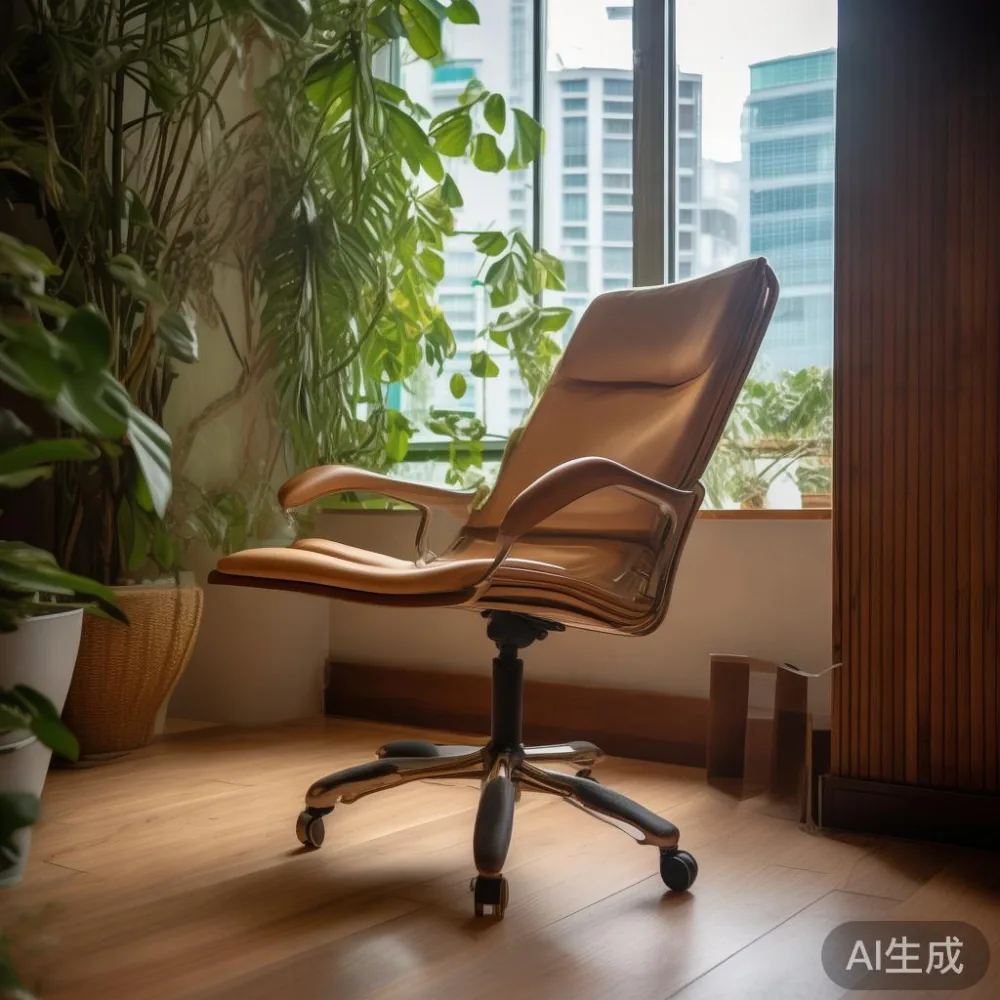
1. Frame movement. The rubberwood or ash inner frame of an ergonomic chair will swell at the seat rails by 1–2 mm during peak wet season. That is enough to make a pneumatic cylinder stiff, which is why some users feel their ergonomic chair has "got stuck". It has not broken; the rail has simply expanded into the cylinder housing. The fix is to drop the room RH to 45–50% for a week and the chair returns to normal.
2. Finish blushing. Lacquer and hard-wax oil finishes absorb trace moisture and turn milky at the surface. On a marble table top the stone is unaffected, but the wooden apron beneath can show cloudy patches that wipe off with a microfibre cloth and a drop of beeswax polish.
3. Joinery creep. Mortise-and-tenon joints on a solid wood bed frame or wardrobe will loosen as the tenon shrinks in drier AC air, then tighten again when humidity rises. The seasonal squeak you hear at 3 a.m. is the tenon sliding in its mortise. It is annoying, not structural.
How Do You Choose the Right Solid Wood for a HDB Flat That Has Only One Service Yard?
That is the question I get most often from buyers in Punggol and Sengkang, where corridor widths measure 1.2 m and lift doors 0.9 m, ruling out any piece longer than 2.1 m without disassembly. Here is the working filter I use.
Species: Teak, white oak, and rubberwood are the three species that tolerate Singapore best. Teak’s natural oil content resists fungal growth, an important property when a wardrobe sits 30 cm from a bathroom door. White oak is denser (it floats at 755 kg/m³ versus teak’s 670 kg/m³) and holds a hand-rubbed oil finish beautifully, which suits the post-modern light luxury look many new BTO owners want. Rubberwood is the budget choice: a queen-size bed frame in rubberwood sits around SGD 1,150 ex-fully finished, against SGD 2,400 for the same piece in white oak.
Construction: Look for mortise-and-tenon joinery on bed frames and wardrobes, and dovetail drawers on nightstands. Staples and dowels will pull apart by month eight. A solid wood sofa frame should use kiln-dried hardwood rails, not plywood. Ask for the moisture content reading at the factory — anything between 8% and 12% is acceptable; 14% is a red flag.
Delivery logistics: Standard HDB lift cabin dimensions are 1.5 m deep by 1.2 m wide by 2.3 m tall. A 2 m dining table will not fit upright. Good suppliers ship flat-pack with bolts, and a credible brand will pre-confirm the dimensions in writing before the lorry rolls out. MIDHILL, for example, sends a CAD drawing of each disassembled carton alongside the invoice, which is why I have not had a single "it won’t fit in the lift" callout in two years of recommending them.
What About Pricing, GST, and the Real Cost of Buying from Foshan Direct?
Singapore buyers now pay 9% GST on landed goods above the SGD 400 personal threshold, but a properly invoiced consignment clears GST once at the importer of record. Below is what a typical mid-range living room package looks like when ordered through a Foshan workshop with a Singapore consolidator, in Singapore dollars, landed, GST-inclusive, with delivery to a HDB in Tampines.
| Item | Material | Land price (SGD) |
|---|---|---|
| 3-seater solid wood sofa, French light luxury styling | Ash frame, linen-blend upholstery | 3,850 |
| Marble coffee table, 1.2 m round | Carrara marble top, ash base | 2,150 |
| Italian light luxury sideboard, 1.6 m | White oak, brass handles | 3,400 |
| Queen bed frame with headboard | White oak, mortise-and-tenon | 2,650 |
| Dining table, 1.8 m, seats 6 | Solid white oak, 4 cm top | 2,950 |
| Wardrobe, 2.0 m sliding, 3 doors | Rubberwood carcass, oak veneer | 2,250 |
| Pair of nightstands | White oak | 950 |
Total landed to a 4-room HDB, including consolidation, sea freight, GST, and lift-up installation: SGD 19,650. The same set from a Singapore retail showroom on Orchard Road would land closer to SGD 32,000, because the showroom price embeds two layers of margin plus a 24-month warranty that the Foshan factory — MIDHILL offers a 10-year structural warranty on all solid wood sofa, bed frame, dining table, wardrobe, and nightstand pieces — covers anyway.
For buyers working with a tighter figure, the same factory’s entry-level line, still solid wood but using rubberwood frames and oak-veneered panels, comes in at under 2000 American furniture pricing parity for a full living room set — a useful mental anchor when comparing across currencies. Shipping from Foshan to Singapore takes 12 to 18 days by sea, plus 3 days for customs clearance and lorry delivery into the HDB car park.
Which Design Styles Actually Survive the Equatorial Climate?
Style matters here, because some looks need finishes that handle moisture better than others.
French light luxury — curved cabriole legs, brushed brass details, neutral linen — works well in Singapore because the matte oil finishes breathe with the wood rather than sealing it under a plastic film. A French light luxury cabinet in white oak is a sensible choice for a condo dining room, and the same vocabulary translates naturally into a guest room: French provincial for guest room styling, with a carved headboard and a low footboard, sits comfortably in a 10 m² spare bedroom.
American light luxury — think deep button-tufted headboards, oversized nailhead trim, dark walnut tones — is the harder sell here. Dark finishes show dust and water rings more readily, and high-gloss lacquer can blister if the wardrobe sits in a west-facing room. If you are weighing how to choose American sofa styling for a Singapore living room, my honest advice is to pick performance linen over the traditional velvet shown in American catalogues, and to specify a removable, washable cushion cover.
Post-modern light luxury — geometric forms, mixed materials, thin metal inlays — pairs particularly nicely with the Italian light luxury sideboard category, where marble, brass, and pale oak meet in a single piece. For shoppers browsing for sale Italian light luxury furniture in Singapore, the practical checklist is unchanged: kiln-dried solid wood carcass, brass that is PVD-coated rather than plated, and marble that is resin-treated so coffee rings wipe clean.
Coastal styling — washed oak, rope details, soft blues — is an under-rated option for Singapore buyers who want a calm, holiday-feeling living room. The trick is keeping the palette pale enough that the inevitable afternoon sun does not yellow the linen. A Coastal for small living room package, with a 2-seater sofa, a 1 m round marble table, and a low oak TV console, fits a 14 m² HDB living room without crowding the corridor sightline.
How Should You Acclimatise New Furniture the Moment It Arrives in Your HDB?
This is the step most buyers skip, and the one that saves the most pieces. When the cartons arrive at your block’s loading bay, do not unpack everything at once. Move the cartons into the air-conditioned living room and leave them closed for 48 hours. The sealed pack lets the wood slowly equalise with indoor RH. After 48 hours, open the cartons, assemble the bed frame or dining table, and leave it another 24 hours before placing heavy objects on the top. For a solid wood sofa, give it 72 hours before sitting on it daily.
If you have bought a piece that ships fully assembled — common with smaller nightstands or a marble table — wipe the surfaces with a dry cloth every evening for the first two weeks. This prevents the trace dust that holds moisture against the finish.
Two more local notes. First, do not place any solid wood piece directly against an external wall, even in a condo. The temperature differential between the wall and the room air causes surface condensation on humid nights. Keep a 5 cm gap. Second, if you are buying from a Foshan supplier you have not visited in person, ask for the workshop video — a five-minute walk-through of the production line, the acclimatising chamber, and the QC bench. Foshan Lingzhan and its neighbouring factories in the Longjiang furniture corridor have been doing this since the early 2000s, and the better ones will send the video unprompted.
When Should You Call a Refinisher, and When Is It Warranty?
A 10-year structural warranty covers joint failure, frame cracking, and major movement that exceeds 5 mm across a panel. Surface wear, finish blushing, and minor seasonal movement are not warranty items. Most Foshan factories — including MIDHILL — offer a lifetime refinishing service for a small handling fee, typically SGD 180 to SGD 380 per piece, which includes collection from your HDB, sanding, re-oiling, and return delivery. For a queen bed frame refinish, budget 14 working days from collection to redelivery.
If your ergonomic chair develops a stiff cylinder or a wobble in the lumbar pivot during the wet season, that is usually moisture-related and reversible. Wipe the metal parts with a dry cloth, run the air-conditioner for an afternoon at 23°C, and the chair should free up within 24 hours. If the wobble persists, the internal bearings may be worn and the chair manufacturer should replace them under the chair’s separate warranty — usually 3 years on pneumatic cylinders and 5 years on the frame.
A Practical 10-Point Checklist Before You Click "Buy"
1. Confirm moisture content is 8–12% at the factory. 2. Ask for the acclimatising chamber protocol in writing. 3. Verify each carton dimension against your lift cabin (1.5 m × 1.2 m × 2.3 m for standard HDB). 4. Specify mortise-and-tenon on bed frames and dovetail drawers throughout. 6. Pick rubberwood for budget, white oak for premium, teak for outdoor-adjacent pieces. 7. Order performance linen over velvet for upholstered seating. 8. Plan a 48-hour indoor acclimatisation on arrival. 9. Keep a hygrometer in the bedroom; 50–55% RH is the sweet spot for wood. 10. Keep the supplier’s refinishing contact in your phone — you will likely use it at year five.
Buying solid wood furniture for an HDB or condo in Singapore is not the same exercise as buying for a dry-climate apartment. The piece has to survive 80%+ outdoor humidity, 50–55% indoor humidity, corridor handling, and lift restrictions, then look good for a decade. Pick the species for the climate, the construction for the joinery, the supplier for the acclimatising chamber, and the style for your actual daily use rather than the catalogue fantasy. Do those four things well, and the 1.8 m dining table will still be flat at Bedok Reservoir ten years from now.